



Claes Oldenburg & Coosje Can Bruggen. Public Sculpture, Architecture and Urbanism
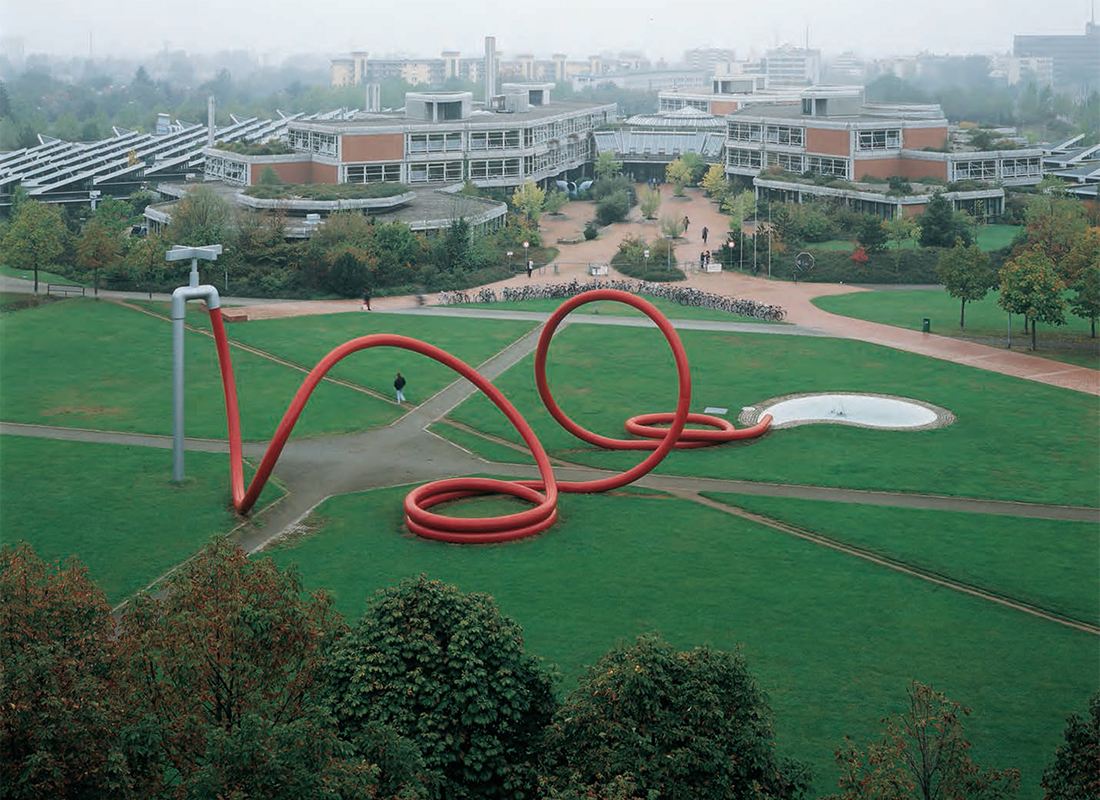
All of Claes Oldenburg and Coosje van Bruggen’s public sculptures are linked to messages of various sorts; however, in this text, it is their dialogue with urbanism and architecture that we seek to summarize, drawing on our book about their artistic work.1
In 1981, with the work Flashlight installed on the University of Las Vegas campus, Oldenburg and van Bruggen applied some of the points expounded in Robert Venturi and Denise Scott Brown’s Learning from Las Vegas. Like Venturi and Scott Brown, Oldenburg and van Bruggen defended the idea of a new popular symbolic art. For Venturi and Scott Brown, Las Vegas provided stimulating examples of a symbolic architecture in opposition to the formalism of the modernists. Likewise, Oldenburg and van Bruggen created a symbolic sculpture tied to social and artistic messages that took a stance against the artistic formalism defended by Clement Greenberg’s disciples. They share Venturi and Scott Brown’s critique of modernism, notably represented by Mies van der Rohe, faulting it for being confined to a sparse and unacknowledged symbolism that glorifies technology and the industrial world. Further targets of Venturi and Scott Brown’s objections are the heroic and anachronistic bombast of the modernists, their taste for the monumental, notably expressed in skyscrapers, their elitism and their authoritarian urban theories tied to the ideology of the tabula rasa; a critique with which Oldenburg and van Bruggen also agree. Venturi and Scott Brown attempted to invent a new functional and symbolic architecture in drawing from the
…