



World of Matter, or Complex Thought about Terrains
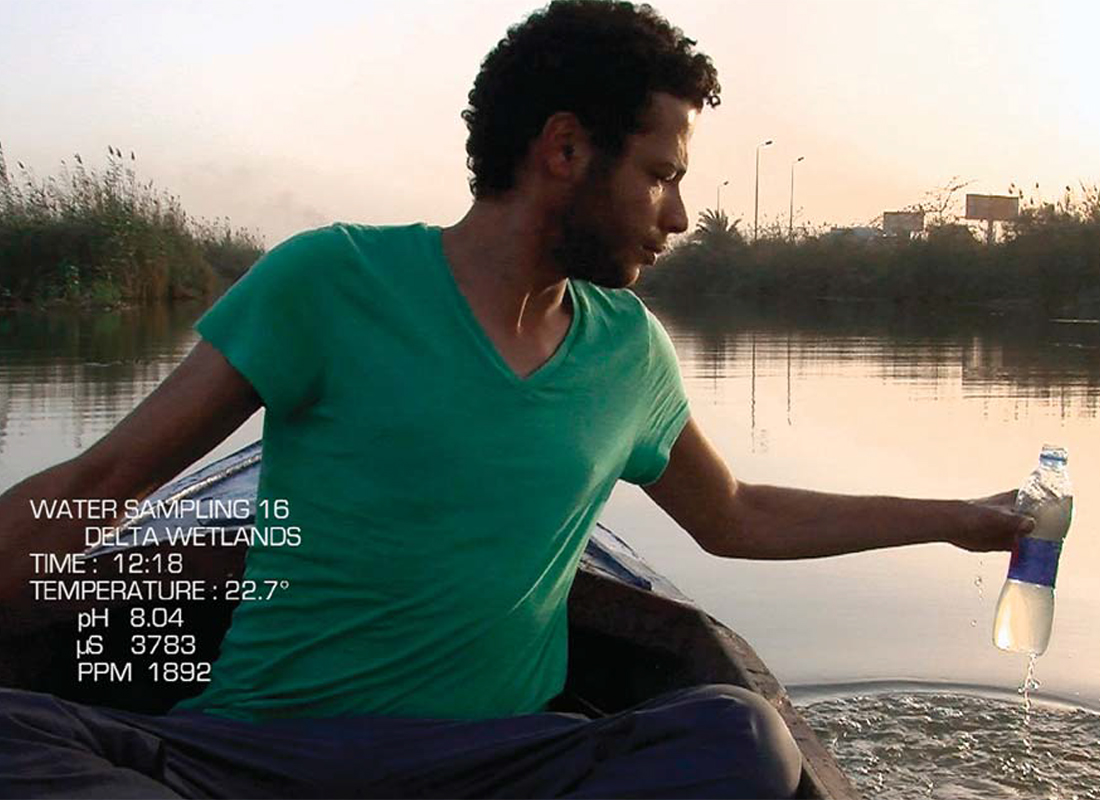
When I speak of complexity, I am referring to the primary meaning of the Latin word “complexus,” “that which is woven together.”
-Edgar Morin
While the environmental issue has been and continues to be widely expressed in an alarmist context, many artists now believe that such an urgent matter demands we take the time instead to conscientiously examine our epistemic frameworks of nature. We need only consider Mark Dion’s cabinets of curiosities and other re-envisioned archaisms (Theatrum Mundi: Armarium, 2001), Simon Starling’s co-evolutionary relationships between visual culture, science and nationalism (Black Drop, 2012; Island for Weeds, 2003), Walton Ford’s critical return to the naturalist tradition (Delirium, 2004) and the time capsule that Trevor Paglen sent into the Earth’s orbit for time immemorial (The Last Pictures, 2012). It would seem that by addressing the ecological present from the standpoint of its dense historical memory, these practices moderate the eschatological urgency through an evocative power that Dieter Roelstraete calls an “archaeological imaginary.”1
In addition to demonstrating diachronic depth, the collective project World of Matter’s fieldwork also falls within a range of practices that explore the entanglement of the material environment with human and cultural structures in synchronic and geographically distributed terms. Their research activities weave interrelations between Canada, Bangladesh, Egypt, Liberia, the Netherlands, India, and Burkina Faso, to name just a few, by investigating and analysing the distribution of raw materials. Originally called Supply Lines, the collective subsequently wished to move away from an anthropocentric view of
…